Executive Summary
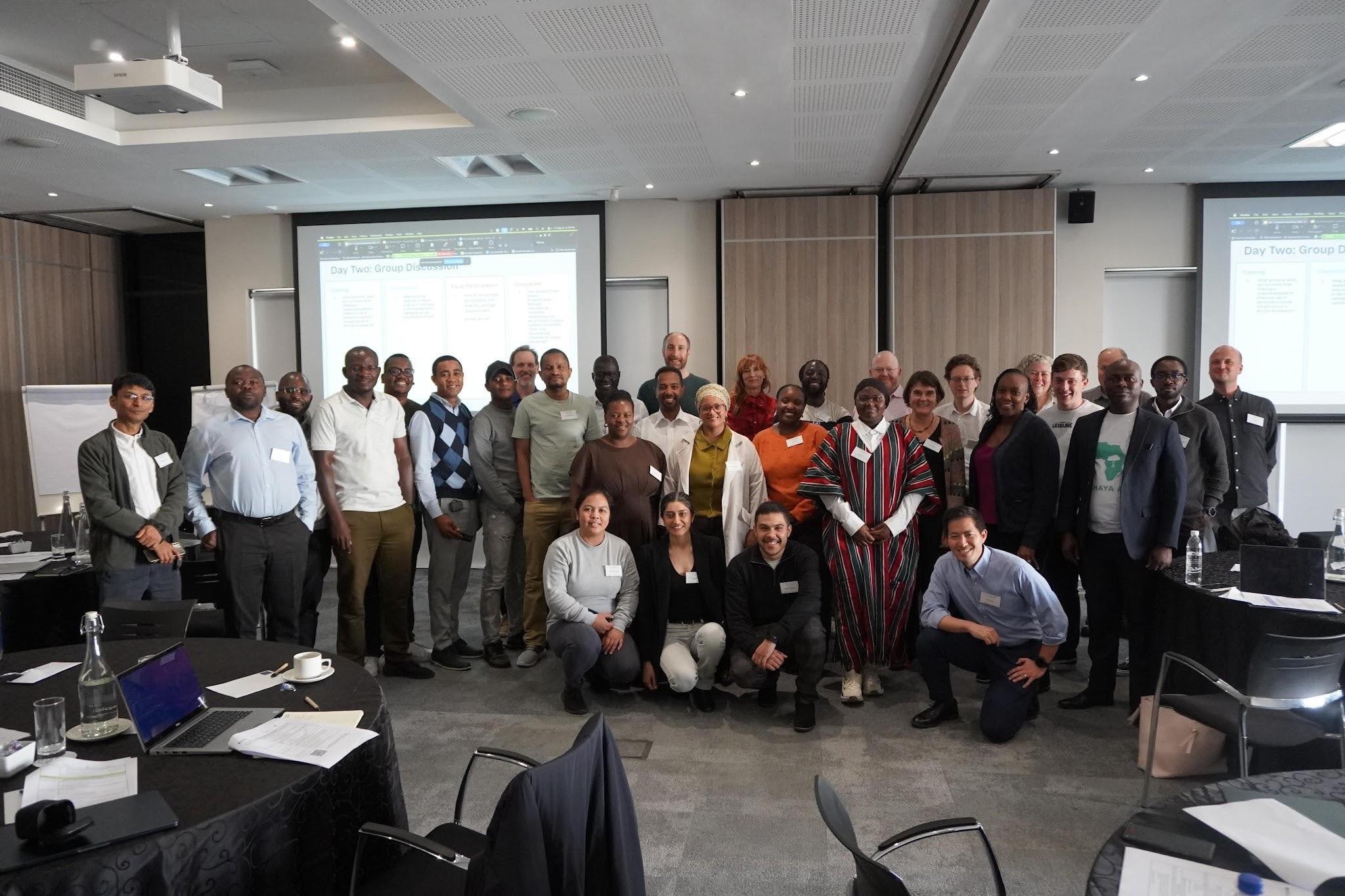
This report synthesizes key discussions and strategic takeaways from the ACI Inception Workshop. The sessions convened researchers, hardware architects, and governance experts to design a regional high-performance computing (HPC) cluster and develop a sustainable AI research ecosystem across Africa.
Day One: Building the Compute System
Infrastructure and Governance Models
The opening sessions established a foundational logic model for the ACI: balancing compute provision, marketplace creation (e.g., AI4D labs), and ongoing research into user practices. Early discussions focused heavily on navigating regional political constraints and establishing robust training pipelines to upskill researchers.
Navigating Compute Constraints
Patrick Walukagga (Sunbird AI) outlined the engineering behind their regional language models, Sunflower 14B and 32B. They successfully trained these models utilizing a single node equipped with 8× H200 GPUs and ZeRO3 optimization. A critical takeaway from their experience is the necessity of resilient, high-capacity storage architectures to prevent bottlenecks during long-running training jobs.
Community Scoping and Governance
Discussions surrounding the regional operating entity highlighted the complexities of compute distribution. Key themes included:
- Prioritizing locally relevant research and investing in regional skills.
- Defining "equitable distribution." Participants debated whether resources should be allocated equally among all users or weighted toward critical, high-impact research areas such as public health and climate.
- The imperative of designing a long-term, self-sustaining economic model for the cluster.
System Architecture and Design
Prof. Rob Simmonds detailed the technical blueprint for the ACI cluster. The purchasing plan is strictly driven by maximizing Return on Investment (ROI) via scientific output and minimizing Time to Science (TTS).
- Networking and Storage: The design mandates 400Gb/s Ethernet (RoCE v2) to simplify internal operations. The architecture relies heavily on Ceph storage, favoring technologies with proven local support capabilities to reduce operational risk.
- Hardware Configuration: The cluster will deploy a tiered architecture featuring high-end GPUs (e.g., H100, H200), mid-range units (L40, L40s), and CPU-only nodes for pre/post-processing tasks.
- Discussion Points: Participants debated the merits of Ceph versus Lustre, sustainable cooling methods (including liquid cooling and reusing heat for electricity generation), and rigorous job-vetting protocols. Capacity building (CB) to support early-career scientists was emphasized as a non-negotiable design pillar.
Institutional HPC Lessons
IDIA: The Inter-University Institute for Data Intensive Astronomy emphasized designing infrastructure backward from actual scientific workflows. They highlighted massive data pipelines like those processing telemetry from the MeerKAT radio telescope, as well as EuroHPC projects like MAELSTROM, which integrates machine learning with complex weather and climate simulations. Their core philosophy is to measure tangible scientific outcomes and isolate system bottlenecks, rather than relying solely on raw job utilization metrics.
UCT HPC: Showcased a heavily partitioned architecture where users are matched with the specific GPU tier (L40s, A100s, H200s) most appropriate for their workload—whether inference, debugging, or deep training. Job scheduling and fairness are enforced via strict SLURM time limits.
Technical Breakout: Focused discussions explored the prohibitive costs of benchmarking and the operational complexities of deploying open-source management overlays like OpenStack and OpenOnDemand.
Day Two: Building the Ecosystem
Global and Emerging Use Cases
Albert Kahira (AstraZeneca) provided an overview of global HPC advancements. The presentation highlighted leading supercomputing architectures in Germany (JUWELS), Spain (MareNostrum), and Japan (Fugaku). The session focused on the deployment of distributed training methodologies and hybrid parallelism vs single-node usage to efficiently scale massive Deep Neural Networks across compute nodes. The session also had insights on usage of technologies like Kubernetes, OpenStack, and object storage in the HPC cluster that is intended to be built.
AI4D Labs and Infrastructure Demand
During the use case alignment session, I detailed our lab's current compute ecosystem and structural bottlenecks:
- We utilize KENET's L40s infrastructure for computer vision workloads, such as Zebra re-identification.
- For our hydro-meteorological modeling, we operate entirely on the CSCS Daint environment. I outlined our core intention of developing weather emulators, also highlighting some of the work I am starting on unsupervised anomaly detection of precipitation across sparse observation station networks utilizing Graph Neural Networks (GNNs), and some of the work that our lab intends to undertake such as Downscaling, Bias Correction and Forecasting.
- I also mentioned others' usage of HPCs where I highlighted work in Automatic Speech Recognition, knowledge distillation for both computer vision and bird sound classification, and rheumatic heart disease detection.
I stressed that our current Time to Science (TTS) averages 21 days, heavily bottlenecked by the complexities of environment setup, strict configurations, and data ingestion. I also stressed that while we have access to these resources, it is not enough if we (Africans) intend to do more research in solving African problems, and generally improving African representation in the research and science landscape.
Identifying and Forecasting Demand
The closing breakout sessions, facilitated by Annette Hubschle and Matthew Smith, challenged groups to identify research frontiers currently bounded by compute access.
- Climate and Physical Systems: I advocated for treating weather data as highly complex "big data" requiring massive, dedicated compute. Pointing to the compounding risks of phenomena like El Niño (which are already being warned that the 2026 one might be risky) on agriculture and health, I argued that the AI community must move beyond localized solutions—like agricultural chatbots—toward holistic, cross-sector models that directly connect AI to physical Earth systems.
- Simulation and NLP: Other researchers proposed leveraging HPC to run digital twin experiments for synthetic data generation. In the NLP domain, discussions highlighted the use of active learning pipelines to dynamically parse and select optimal subsets of massive datasets for translation models.
Reflections: What Stood Out for Me
The Strategic Vision of the ACI
The sheer scale and ambition of the Africa Compute Initiative was the most prominent takeaway from this workshop. It was particularly encouraging to see that AI4D labs are positioned to receive priority access in the compute distribution models. Furthermore, the governance and design discussions were genuinely collaborative; it is a massive step forward to have the actual workflows, bottlenecks, and views of local applied researchers taken into direct consideration before the hardware is even procured.
The Scale of African Data and the Compute Bottleneck
It is abundantly clear that the primary constraint inhibiting African research is not a lack of talent or data, but a severe bottleneck in computational infrastructure. We are already undertaking world-class, data-heavy science on the continent. An example that was discussed is South Africa's MeerKAT radio telescope. The scale of this project is staggering: its high-frequency dishes alone produce data at rates that rival or exceed total global internet traffic (scaling into terabytes and petabytes per second). Processing this data requires immense supercomputing power—specifically for complex algorithmic splitting and image reconstruction to solve inverse problems. Without localized, high-performance infrastructure, critical projects like these, alongside our own work in geostatistics and weather modeling, remain fundamentally throttled by Time to Science (TTS).
Inspiration from Global HPC Standards
The workshop frequently benchmarked our goals against some of the most advanced supercomputers in the world. Looking into their architectures reveals exactly why they represent the gold standard for what ACI is trying to build:
- Fugaku (Japan): Fugaku is renowned for its extreme versatility and scalability. It was the first supercomputer to simultaneously top world rankings in raw speed, AI processing, big data, and practical applications. Its societal impact is a perfect blueprint for ACI, as its immense power was rapidly redirected during the COVID-19 pandemic to simulate indoor droplet spread and drastically accelerate therapeutic drug discovery.
- MareNostrum 5 (Spain): Hosted at the Barcelona Supercomputing Center, this 314-petaflop pre-exascale system is a masterclass in sustainable computing. It stands out for its highly efficient hybrid architecture and its Energy Aware Runtime (EAR) framework. Combined with advanced direct liquid cooling, MareNostrum 5 proves that massive computational output does not have to come at the expense of energy efficiency—a crucial consideration for African infrastructure.
- JUWELS (Germany): JUWELS pioneered the "modular supercomputing architecture." Instead of a monolithic system, it seamlessly bridges a highly capable CPU Cluster module with a massive NVIDIA GPU Booster module. This architectural flexibility makes it one of the best in the world at dynamically serving diverse research communities, simultaneously handling everything from complex Earth system climate simulations to cutting-edge AI model training.